Blog / AI agents
E2B Alternatives That Run Agents in Strict Isolation
Explore the top e2b alternatives including Daytona, Modal, Northflank, and Vercel Sandbox to find the right isolated runtime for your AI agents.
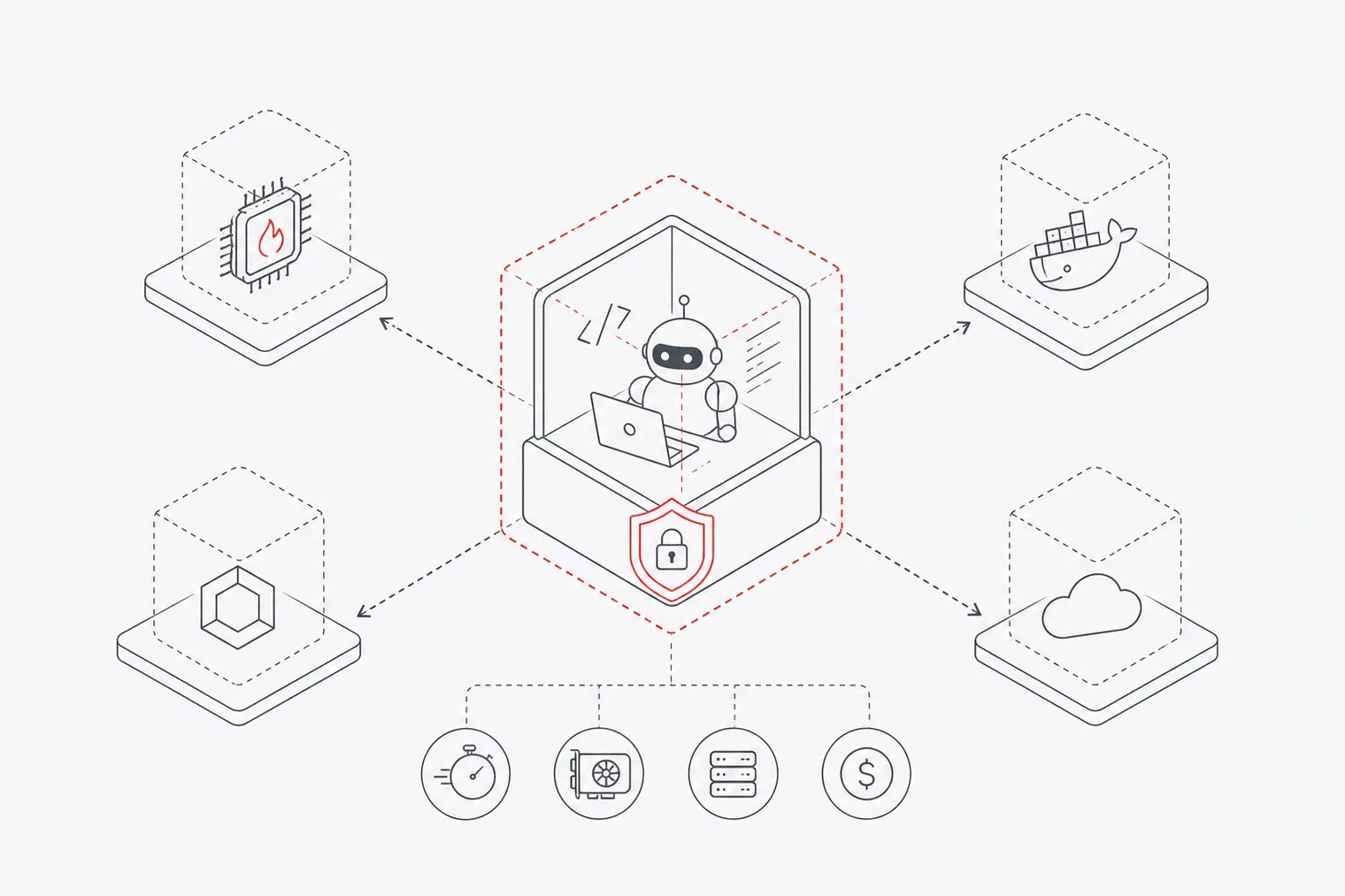
The main E2B alternatives are Daytona, Modal, Northflank and Vercel Sandbox, each strongest on a different constraint: start-up speed, GPUs, long sessions or ecosystem fit. If your requirement is that sandboxes and API keys stay on your own hardware, a self-hosted runtime is the better fit, either E2B's own open-source infrastructure or a local-first tool like Hotcell.
E2B is the default choice for many teams. In Armature's 2026 study, E2B was chosen in 44% of 520 judged code-sandbox sessions. Its managed plans come with constraints: sessions are capped at one hour on the entry plan and 24 hours on the higher tier, CPU and RAM are set per template, and there are no GPUs. Teams hitting those walls need a clear picture of what else is available.
E2B Alternatives at a Glance
The table below compares the options on isolation model, GPU support and self-hosting. The market moves quickly (Growth Market Reports projects 22.1% annual growth for AI sandbox environments through 2033), so verify specifics before committing.
| Tool | Isolation model | GPUs | Self-host / BYOC |
|---|---|---|---|
| E2B | Firecracker microVMs | No | Open-source infra you can self-host; BYOC on enterprise plans |
| Daytona | Containers by default, optional VM sandboxes | Yes | BYOC on enterprise plans |
| Modal | gVisor (VM runtime also available) | Yes | No |
| Northflank | microVMs (Kata Containers) or gVisor, per workload | Yes | BYOC supported |
| Vercel Sandbox | Firecracker microVMs | No | No |
| Hotcell | Docker, Firecracker or Apple Virtualization, on your own hardware | No | Self-hosted by design |
What Makes an E2B Alternative Worth Switching To?
The right replacement depends on which constraint is actually hurting you. Session length, start-up latency, GPU access and data residency pull teams in different directions.
Isolation model is the foundation. Firecracker microVMs give each sandbox its own kernel with low overhead. gVisor intercepts system calls in user space, trading some performance for compatibility. Containers are fastest but share the host kernel unless wrapped in a VM.
Session limits matter for long-running agents. E2B caps sessions at one hour on the entry plan and 24 hours on the higher tier. Pausing a sandbox takes roughly four seconds per GiB of RAM, while resuming takes about one second, so agents that pause and resume often should keep memory small.
SDK maturity affects how fast you can migrate. E2B's SDK is widely integrated into agent frameworks, so check that an alternative offers the language bindings and framework hooks you depend on.
GPU access is a hard requirement for agents that run models inside the sandbox. E2B has none, so any workload that calls a local model mid-session needs a provider that can attach one.
Daytona: Fast Starts for High-Frequency Agents
Daytona is built for agents that create and tear down environments constantly; it advertises sandbox creation in under 90 ms. Sandboxes are Linux containers by default, with optional dedicated VM sandboxes when you need a stronger boundary.
GPU support is a real differentiator: Daytona's pricing page lists a range of GPUs including H100s. For agents that run inference or fine-tuning steps inside the sandbox, that matters. Enterprise plans also offer bring-your-own-compute. If you plan to depend on Daytona's open-source code rather than its hosted service, check the repository's current activity and licence first.
Modal: Python-First Workloads With On-Demand GPUs
Modal is a strong choice when your agent stack is Python-heavy and needs GPUs on demand. Its sandboxes use gVisor by default, with a VM runtime also available, and its Sandbox SDK supports JavaScript/TypeScript and Go as well as Python.
Modal stands out on GPU choice and billing: it offers GPUs from T4s up to H100s and newer, billed per second with separate line items for CPU, memory and GPU. That suits bursty tasks that need a large GPU for a short time. Sandboxes default to a five-minute timeout and can run for up to 24 hours. gVisor adds overhead on network- and file-heavy work compared with plain containers, so benchmark I/O-heavy agents before committing.
Northflank and Vercel Sandbox: Custom Images and Ecosystem Fit
Northflank runs sandboxes as microVMs (Kata Containers) or with gVisor, chosen per workload, including GPU workloads, and does not impose fixed session time limits, which matters for open-ended agent tasks. It supports custom container images and persistent volumes, and Bring Your Own Cloud on its standard plans, so teams with data-residency requirements can run workloads in their own cloud accounts. Pricing is public on Northflank's pricing page.
Vercel Sandbox is a Firecracker-based managed runtime that fits naturally for teams already deploying on Vercel. Sessions run up to 45 minutes on the Hobby plan and 24 hours on Pro and Enterprise, and persistent sandboxes can resume with the clock reset. There is no GPU support. See Vercel's sandbox pricing docs for current limits.
Is There an Open-Source Alternative to E2B That Runs On-Premises?
For teams where sandboxes and credentials must stay on their own hardware, managed cloud sandboxes aren't the answer, whatever their isolation model. There are two open-source routes.
The first is E2B itself: its infrastructure is open source under Apache-2.0 and can be deployed with Terraform into cloud accounts you operate, and enterprise customers can run E2B's data plane in their own cloud (BYOC).
The second is a local-first runtime. Hotcell, from Directionally Local, runs sandboxes on your own machines as Docker containers, Firecracker microVMs or Apple Virtualization microVMs. Install it with npm i -g hotcell (there's also a Python SDK). A key-swapping gateway gives each sandbox a short-lived, revocable, spend-capped token, so real API keys stay on the host, and admission control and default-deny egress (kernel-enforced on Linux and in microVMs) keep sandboxes in bounds. Directionally Local pairs it with Autopilot, a terminal coding agent that works with any OpenRouter model or your own OpenAI-compatible endpoint. Pair Autopilot with a locally hosted model if your code must not leave the machine either.
How to Choose the Right Sandbox for Your Agent Stack
Match your primary constraint to the tool that addresses it most directly.
| Your primary constraint | Best fit | Why |
|---|---|---|
| Fastest sandbox creation | Daytona | Advertises sub-90 ms creation |
| GPUs inside the sandbox | Modal, Daytona or Northflank | All three offer GPU sandboxes |
| No fixed session limit | Northflank | No forced time limits |
| Custom images and persistent volumes | Northflank | Supported on standard plans |
| Run in your own cloud account | Northflank, or E2B/Daytona on enterprise plans | BYOC options |
| Already on Vercel | Vercel Sandbox | Same Firecracker model, same platform |
| Sandboxes and keys on your own hardware | E2B (self-hosted) or Hotcell | Open source, runs on infrastructure you control |
Start with your hardest constraint and work outward; that narrows the field faster than any feature comparison.
FAQs
Can E2B be self-hosted?
Yes. E2B's infrastructure is open source under Apache-2.0 and can be deployed with Terraform into cloud accounts you operate, and enterprise customers can run the data plane in their own cloud (BYOC). It takes more operational work than the managed service.
Which E2B alternative has no session length limit?
Northflank doesn't impose fixed session time limits, which suits long-running or open-ended agent tasks. Vercel Sandbox caps each session but lets persistent sandboxes resume. Check current limits with each provider before building on extended sessions.
What is the difference between Firecracker and gVisor isolation?
Firecracker runs each sandbox in a lightweight virtual machine with its own kernel, giving strong isolation with low overhead. gVisor intercepts system calls in user space without a full VM, which improves compatibility but adds overhead, especially on network and file I/O.
Which sandbox options are open source?
E2B's SDK and infrastructure are open source. Hotcell (Apache-2.0) and Autopilot (MIT) from Directionally Local are open source and designed to run on your own hardware. Daytona has published open-source code in the past; check the repository's current status before depending on it.
Does Modal support languages other than Python?
Yes. Modal is Python-first, but its Sandbox SDK also supports JavaScript/TypeScript and Go.
Conclusion
The right E2B alternative depends on what's actually blocking you. Daytona leads on start-up speed, Modal on GPU-heavy Python work, Northflank on long sessions and BYOC, and Vercel Sandbox is the low-friction option for teams already on Vercel. If your requirement is that sandboxes and keys stay on hardware you control, look at self-hosted E2B or a local-first runtime like Hotcell first.