Blog / local AI
Underdog, Nvidia and open weights: big money is moving into local-first AI
a16z backed an AI assistant that runs on your own computer, and Nvidia is buying into open-weight models. What that means for self-hosted coding agents.
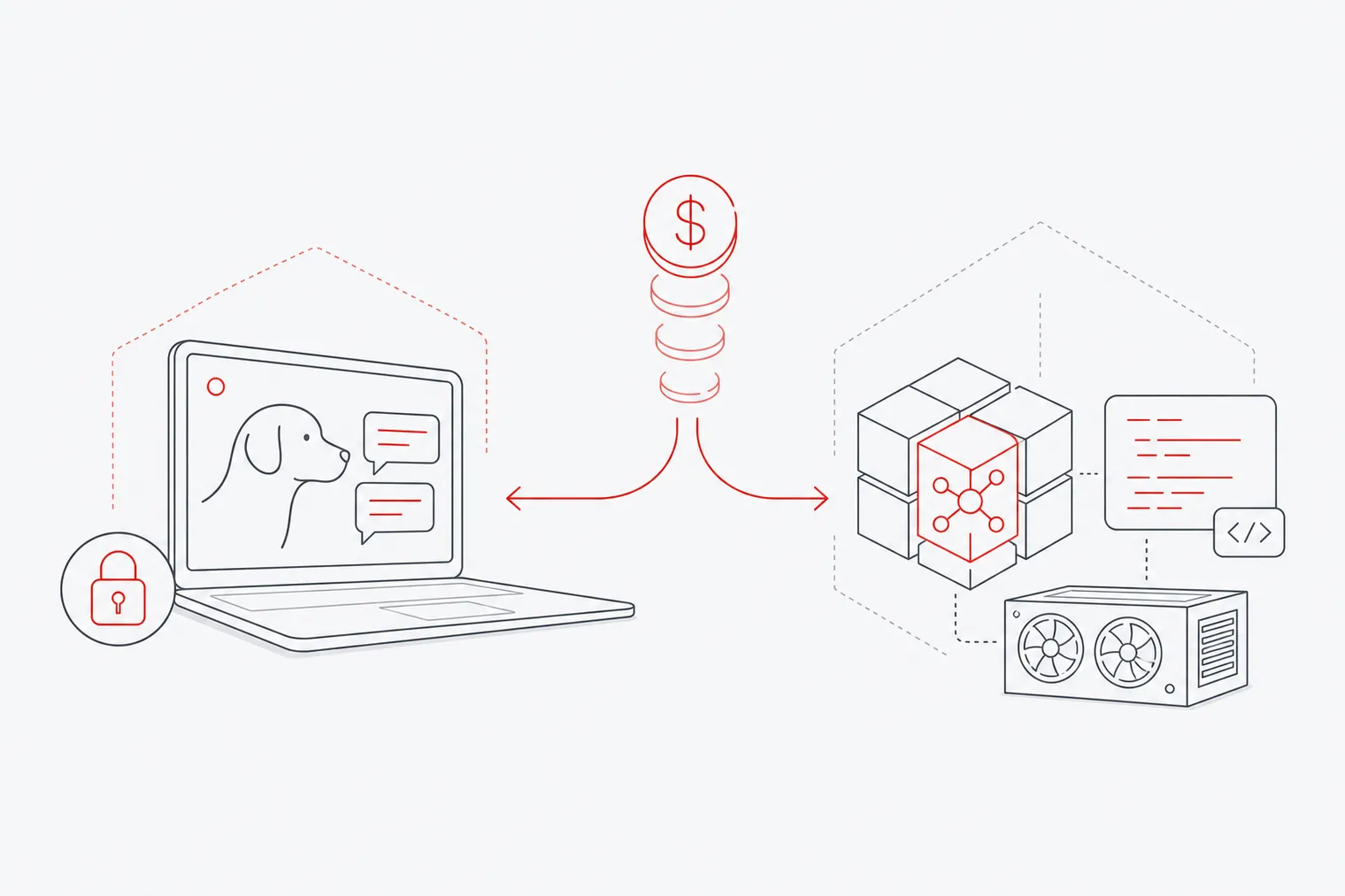
Two signals landed within days of each other in early October 2026. Read separately, each is interesting. Read together, they make a strong case that local-first AI infrastructure has crossed from hobbyist preference into a category that institutional capital is actively validating.
The first: Conway Research's Underdog, an on-device personal AI assistant that runs on your own computer, announced its a16z-backed first round on October 2, 2026. The second: Nvidia was reported by the Financial Times on October 10, 2026 to be in early talks to acquire or deepen its investment in Reflection AI — an open-weight model startup whose "Beam" model runs 501 billion total parameters with 23 billion active, built explicitly to compete with Chinese open models like DeepSeek and Kimi. Neither story is a footnote. Together, they describe a structural shift in where serious money thinks AI is going.
Underdog: a16z Bets on On-Device, Privacy-First AI
Underdog is a consumer product, not developer infrastructure. It's a personal AI assistant that lives on your computer, processes queries locally (with inference engines tuned for Apple silicon), and is built around two properties its founders treat as features rather than constraints: privacy (your data doesn't leave your machine) and near-zero inference cost (you're running on hardware you already own).
The a16z backing matters for a specific reason. Andreessen Horowitz has been one of the most consistent voices arguing that the AI application layer isn't settled — that model-as-a-service is not the only viable commercial path. Writing a first-round check for a product whose entire pitch is "runs on your hardware, private by architecture" is a meaningful signal about where they think durable defensibility lives.
The throughline for developers isn't that Underdog is a coding tool. It isn't. The throughline is that a16z just validated the architectural thesis: on-device inference, with the user's own hardware absorbing compute costs, is a real product category — not a workaround for people who can't afford API credits.
Nvidia's Open-Weight Bet: More Than Chips
Nvidia's reported interest in Reflection AI is the second signal, and arguably the more structurally significant one for anyone thinking about self-hosted infrastructure.
Nvidia is already a chip company. What it's been doing since 2025 is something different: seeding the open-weight model layer. Its agreement to acquire Hugging Face for about $12.9 billion, confirmed in September 2026, was the clearest statement of that strategy. Hugging Face is the distribution layer for open-weight models — where developers pull weights, share fine-tunes, and build pipelines. Owning it means Nvidia has a stake in the ecosystem that runs on its hardware, not just the hardware itself.
The reported talks with Reflection AI extend that logic. Beam is designed to compete on capability with Chinese open-weight models that have already shown frontier-quality reasoning doesn't require a proprietary API. If Nvidia closes this deal, it would own or hold a deep stake in both the primary distribution platform for open models and a competitive open-weight model that developers can actually run themselves.
One important caveat: as of the reporting on October 10–11, 2026, Nvidia has not closed an acquisition of Reflection AI. These are reported talks. The deal may not happen. But the direction of travel is clear regardless of outcome — Nvidia is not content to be a passive beneficiary of AI infrastructure growth. It's actively positioning itself in the open-weight layer.
What These Two Signals Mean for Self-Hosted AI
On-device inference and open-weight models are different bets, but they're adjacent bets on the same underlying idea: that the value in AI doesn't have to flow through a centralized API.
Underdog's pitch is that local inference is private and cheap. Nvidia's open-weight strategy is that capable models should be runnable by anyone with the right hardware. Both of these only pay off if the broader ecosystem around self-hosted AI matures — and that ecosystem includes more than just the model. It includes the runtime, the sandbox, the tooling, and the agent layer that sits between a model and actual work getting done.
This is where the gap becomes visible for developers who want to run coding agents on their own infrastructure. A capable open-weight model is a necessary condition, not a sufficient one. You also need a way to run that model as an agent — with tool use, multi-step reasoning, and the ability to execute code without exposing your real environment to a subagent that might do something unexpected.
The Missing Piece: Agent Runtime and Sandbox
The capital flowing into on-device AI and open-weight models is validating the model layer. What it doesn't automatically provide is the agent infrastructure layer above it.
Running a coding agent safely is a different problem from running a model. When an agent can write and execute code, you need isolation. You need to know that a subagent spinning up a subprocess can't reach your real API keys, can't modify files outside its working directory, and can't make network calls you didn't authorize. That's not a model problem. It's a sandbox problem — and it's not a trivial one to solve yourself. Building isolated microVM or container environments that spin up fast enough to be useful inside an agentic loop, while remaining genuinely isolated, requires real infrastructure work.
Directionally Local is an open-source stack built specifically for this layer. Autopilot is a terminal-based coding agent and programmable SDK that runs on your own key with 25+ providers, including OpenRouter's 400+ models, local Ollama and LM Studio, or any OpenAI-compatible endpoint — meaning it works with the open-weight models Nvidia is seeding into the ecosystem right now. Hotcell is the sandbox layer beneath it, spinning up isolated microVMs or containers on your own machine so agent subagents never touch your real API keys.
Both are free and open source. You run them on infrastructure you control.
The timing matters. As open-weight models become more capable and capital validates on-device inference as a durable category, the question for developers shifts from "should I self-host?" to "how do I self-host an agent runtime that's actually safe to run?" Autopilot and Hotcell are built to answer that second question.
The Broader Pattern
What October 2026 is showing isn't a single trend — it's a convergence. Consumer AI products are being architected around local inference and privacy. The largest AI hardware company in the world is buying into open-weight model distribution. A16z is writing checks for on-device AI that runs on hardware people already own.
None of these moves make sense if local and self-hosted AI is a niche. They only make sense if the people writing the checks believe it's going to be a significant part of how AI gets used — not as a fallback when cloud APIs get expensive, but as a primary architecture for products and workflows where privacy, cost, and control actually matter.
For developers building with coding agents today, the infrastructure to run that architecture already exists. The model ecosystem is maturing fast. The sandbox and agent runtime layer is the piece that still requires deliberate tooling choices.
Frequently Asked Questions
What is local-first AI infrastructure? Local-first AI infrastructure refers to systems where AI models run on hardware you own or control — your laptop, your server, your on-premises machines — rather than sending queries to a remote cloud API. The model weights, the compute, and the data all stay within your environment.
Is Nvidia's acquisition of Reflection AI confirmed? No. As of October 10–11, 2026, Nvidia was reported by the Financial Times to be in early talks with Reflection AI. No deal has been announced or closed. The situation may change, but the reporting itself signals Nvidia's strategic interest in the open-weight model layer.
What is Underdog and why does it matter for developers? Underdog is a consumer personal AI assistant that runs locally on your own computer, backed by a16z. It's not a developer tool. It matters for developers because a16z's investment validates the architectural thesis that on-device, privacy-preserving AI is a real product category — which strengthens the broader case for self-hosted AI infrastructure.
What is the difference between an open-weight model and a proprietary model? An open-weight model releases its trained parameters publicly, so anyone can download and run it on their own hardware. A proprietary model is only accessible through an API controlled by the company that trained it. Open-weight models make self-hosted AI viable because you're not dependent on a third-party endpoint.
What does Hotcell actually do in a coding agent setup? Hotcell spins up isolated microVMs or containers on your own machine so that when a coding agent executes code or runs subagents, those processes can't access your real API keys, your broader filesystem, or make unauthorized network calls. It provides the isolation layer that makes running autonomous coding agents safe.
Can Autopilot work with open-weight models like Beam or DeepSeek? Autopilot connects to any OpenAI-compatible endpoint, which includes self-hosted open-weight models served through compatible inference servers. If a model is available through OpenRouter or a local inference endpoint you control, Autopilot can drive it.
Where can I learn more about Directionally Local? You can find Autopilot, Hotcell, and the full open-source stack at directionallylocal.com.